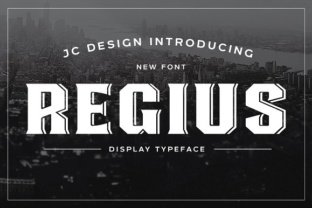
Regius: A Retro Art Deco Typeface for Packaging and Beyond
Choosing a typeface for a brand or product line often feels like a search for the perfect voice. You need something that carries a story, yet remains legible at a glance. Regius was originally created as a corporate typeface for packaging design, drawing inspiration from old English pub signs. The result is a retro font with simple, clean shapes and reduced ornamental structures, yet it still carries a distinct art deco influence. For designers and brand owners who value process and practical execution, Regius offers a bridge between nostalgic character and modern usability.
What Regius Brings to Your Design Workflow
Regius fits into the planning and execution phases of any project where visual tone matters. Its simplified forms mean less visual noise, which directly supports brand consistency across different media. The art deco undertones add a hint of early twentieth-century elegance, but the simplification makes it more readable in small sizes or on complex packaging surfaces.
When you are mapping out a creative process, typeface selection usually happens right after the initial brand strategy is defined. Regius is a strong candidate when your brief calls for a retro, handcrafted feel without sacrificing clarity. It works equally well on a box, a label, a store sign, or a digital header. Because its shapes are straightforward, you can scale it from a large billboard down to a product barcode area without distorting the personality.
Before the Project: Evaluating Regius for Your Needs
Integration starts with planning. Before you commit to a typeface, assess how it aligns with your overall design system. Regius’s reduced ornamentation means you can pair it with more intricate serif or script fonts for contrast. For example, if your packaging includes detailed illustrations, Regius will anchor the text without competing. Its art deco influence also suggests a color palette rooted in muted golds, deep greens, or blacks – but the font remains versatile enough to work with contemporary pastels or bold hues.
Consider your production process as well. If you are working with a printer who uses flexography or digital printing, test how Regius renders in small point sizes. Because its strokes are clean and its counter spaces open, it handles common print challenges like ink spread or registration errors better than highly detailed scripts. This reduces the need for last-minute adjustments during proofing.
During Execution: Practical Implementation of Regius
When you start designing, use Regius as a display typeface for headlines, product names, and key callouts. Its simple shapes make it ideal for embossing or foil stamping because the letterforms remain distinct even when raised or metaled. For body copy or ingredient lists, consider pairing Regius with a neutral sans-serif like Helvetica or a clean serif like Times New Roman. The contrast will enhance readability while preserving the retro feel.
One common mistake is to overcrowd the design with too many retro elements. Regius already carries historical weight, so keep supporting graphics minimal. A single line border or a subtle art deco frame is often enough. In your layout software, adjust tracking and kerning carefully. Regius’s reduced ornamentation means that tight letter spacing can blur the character shapes; give it a little breathing room, especially on curved packaging surfaces.
If you are creating a brand style guide, include Regius in your typography section along with fallback fonts. Specify use cases: primary logo, secondary taglines, and accent text. Also define minimum size to maintain legibility – typically 10pt for print and 14px for digital. This documentation ensures that everyone on the team, from designers to production managers, applies the font consistently across projects.
Interacting with Other Tools and Assets
Regius works seamlessly with Adobe Creative Suite, Sketch, Figma, and most design tools. Because it is a vector font, it scales without degradation. You can also use it in web design by converting it to a web font format or via @font-face. Just be mindful that the art deco character might require a specific background color or texture to shine. On digital screens, avoid placing it on busy images; instead, use a subtle tint or a solid color block behind the text.
For packaging, consider the substrate. On corrugated cardboard or textured paper, Regius’s clean lines prevent loss of detail. If you use a gloss laminate, the simple shapes reduce glare and reflection issues compared to highly decorative scripts. This practical advantage saves time during mockup reviews and final approvals.
After Launch: Long-Term Consistency with Regius
Once your product is in the market, maintaining brand consistency becomes a quality control task. Stores, online retailers, and promotional materials all need to use the same typeface. Regius’s particularly simple form reduces the chance of mis-ripping or font substitution when files are passed between agencies. You can include the font files in your digital asset repository along with usage guidelines. If a new team member needs to create a seasonal label, they can quickly match the existing look without re-designing.
Another long-term advantage is that the retro art deco style of Regius does not date quickly. Unlike trendy typefaces that look outdated after two years, Regius taps into a classic aesthetic that remains appealing. This is especially valuable for small business owners or entrepreneurs who plan to grow a product line over several years. The font becomes part of the brand’s heritage, not a short-term experiment.
Quality Control in Multi-Product Lines
If you manage multiple SKUs, Regius helps unify them visually. For example, you can use bold weights for premium products and lighter weights for economy versions. The simplified shapes ensure that even different weights carry the same core personality. This approach reduces the need for separate logo designs for each product variant, saving both time and money. You can also create a hierarchy using size and color, not additional ornamentation, which keeps the system clean.
When auditing your packaging across stores, check that the printing matches the approved spec. Regius’s reduced ornamentation makes it easier to spot registration errors – a shifted serif or missing curve is obvious. If you see blurry corners, you know the printer needs to adjust. This clear feedback loop improves long-term relationships with manufacturers and cuts down on reprints.
Regius in Digital and Marketing Workflows
Your brand doesn’t live only on packaging. It extends to websites, social media, newsletters, and advertisements. In digital contexts, Regius works well for hero headers and call-to-action buttons. Its art deco feel pairs nicely with modern minimal layouts – the contrast draws the eye. When designing emails, use Regius sparingly because it may not be installed on all devices; embed it or use a fallback like Impact or Oswald that echoes its proportions. For social media graphics, create templates where Regius is the primary font for quotes or product announcements. This reinforces recall across channels.
If you run online ads, consider using Regius in animated banners. The simple shapes animate cleanly without strange artifacts. A fade-in or slide effect works better than complex morphing. This keeps production time low while maintaining a cohesive brand experience.
Practical Tips for Hobbyists and Freelancers
Even if you are not a corporate designer, Regius can elevate personal projects. Use it for event posters, business cards, or an Etsy shop logo. The reduced ornamentation means you can even hand-draw the letters for a custom touch if you have limited software skills. For bloggers, using Regius in your site’s header gives a professional, curated appearance without the expense of custom lettering. Pair it with a clean sans-serif for blog posts, and your readers will associate the style with a well-made, thoughtful content.
When learning design, studying Regius can teach you about the balance between decoration and clarity. Compare it to a highly ornate art deco font and note how each stroke has been simplified. This understanding helps you make better typeface choices in future projects. You can also experiment with altering the color or texture behind Regius to create your own retro palette, whether for a side business or a personal brand.
Getting Started with Regius in Your Routine
To integrate Regius smoothly, start small. Pick one upcoming project – a single product label or a flyer – and use Regius as the primary display font. Build the rest of the design around its proportions. After completion, evaluate how it affected your workflow: Did you need fewer revisions on spacing? Did the client respond positively to the nostalgic tone? Use that feedback to decide whether to expand its use across your entire brand. Because Regius is simple and not overly stylized, it adapts well to both one-off uses and long-term anchors.
If you work in a team, share the font file and a one-page usage guide. Highlight the key weights and recommended pairings. This prevents confusion and ensures that any new designer can pick up the system quickly. For larger enterprises, consider licensing the font for all company touchpoints. The investment pays for itself when you no longer have to hunt for missing fonts or recreate logos from scratch.
Conclusion: Regius as a Process-Oriented Choice
Regius is more than a retro typeface – it is a tool that supports efficiency, consistency, and clarity throughout the design and production process. Its old English pub sign inspiration gives you a story, while the simplified art deco shapes give you control. Whether you are a marketer planning a product launch, an entrepreneur building a brand, or a freelancer seeking a reliable display font, Regius fits naturally into your workflow without extra decorative baggage. By using it thoughtfully before, during, and after your projects, you create visual harmony that stands out against cluttered shelves and scrolling feeds.
Take the time to test it with your typical materials and output methods. You may find that Regius becomes a central part of your creative toolkit – not because it is trendy, but because it works.