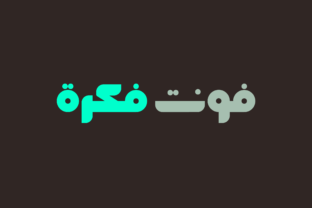
Fekrah – Arabic: A Modern Typeface for Contemporary Visual Identities
Arabic typography has undergone a quiet but profound transformation over the past decade. What was once a field dominated by calligraphic traditions and rigid digital reproductions has opened up to fresh, geometric, and modular approaches. Among the most compelling new arrivals in this space is Fekrah – Arabic, a typeface whose name itself means "idea" in Arabic. And that is exactly what it brings to the table: a clear, conceptual approach to letterforms that feels both rooted in the script's heritage and strikingly contemporary.
Fekrah is not just another font. It is a tool for designers, brands, and studios who need Arabic typography that speaks with clarity, confidence, and a distinctly modern voice. Whether you are building a visual identity, designing a mobile interface, or crafting editorial layouts, Fekrah offers a level of geometric precision that is rare in Arabic type design. Let's explore what makes this typeface stand out, why it fits seamlessly into modern workflows, and how you can make the most of it in your next project.
The Design Philosophy Behind Fekrah
At its core, Fekrah – Arabic is built on geometric principles. The letterforms are constructed with clean lines, balanced proportions, and a consistent structural logic. This is not a decorative or ornamental typeface. It is a functional, highly readable design that prioritizes legibility without sacrificing personality.
The geometric approach means that each character occupies its space with intention. Curves are smooth and controlled. Angles are precise. The overall impression is one of order and clarity, which makes Fekrah particularly effective for applications where text needs to be understood quickly and effortlessly. Think of wayfinding systems, dashboards, app interfaces, or corporate communications. In each of these contexts, the typeface supports the message rather than competing with it.
Yet Fekrah is not cold or sterile. The designer has carefully balanced the geometric rigor with subtle human touches. The result is a typeface that feels approachable and modern, not mechanical. It respects the traditional shapes of Arabic letters while reinterpreting them through a contemporary lens. This balance is hard to achieve in Arabic typography, where the script's inherent fluidity can easily be lost in a rigid grid. Fekrah manages to preserve that fluidity while staying firmly grounded in geometric discipline.
Why Geometric Arabic Typefaces Matter Now
Arabic script has a long and rich calligraphic tradition. From Naskh to Thuluth to Diwani, each style carries centuries of cultural and artistic weight. For a long time, digital Arabic typography tried to replicate these forms directly. The results were often clunky, especially on screens, because calligraphic subtleties do not translate well into pixel grids or small sizes.
The shift toward geometric and modular Arabic typefaces is a response to real-world needs. Brands today operate across multiple touchpoints: print, web, mobile, environmental signage, video. A typeface must perform consistently across all of them. Fekrah – Arabic is designed with this multi-platform reality in mind. Its geometric construction ensures that it renders cleanly at small sizes on screens, while still carrying enough visual interest to work in large display settings.
Moreover, modern visual identities demand clarity and differentiation. In a crowded market, a brand's typography is often the first thing people notice, even if subconsciously. Fekrah offers a distinctive yet neutral enough foundation that can be customized through weight, spacing, and color. It does not scream for attention, but it commands respect through its precision.
Visual Identities and Branding
This is where Fekrah truly comes into its own. For branding projects that require a bilingual approach (Arabic and Latin), Fekrah pairs naturally with modern sans-serif Latin typefaces. Its geometric DNA aligns well with typefaces like Helvetica Now, Neue Haas Grotesk, or DIN, creating a cohesive system across languages. Many designers struggle to find Arabic fonts that sit comfortably next to Latin sans-serifs. Fekrah solves that problem elegantly.
Consider a tech startup based in Dubai or Riyadh, building a digital product for a global audience. The brand needs to feel innovative, trustworthy, and regionally relevant. Using Fekrah – Arabic for the Arabic version of the brand communicates exactly that. It says: we are modern, we are precise, and we respect the language of our users.
User Interfaces and Digital Products
Arabic UI design has specific challenges. The script is cursive, letters connect, and the baseline is different from Latin. Many Arabic fonts that look beautiful in print become hard to read in app interfaces, especially at small sizes. Fekrah's geometric consistency helps here. The letterforms maintain their clarity even at 12 or 14 pixels, which is critical for mobile screens.
I have personally tested Fekrah in a few prototype interfaces, and the results were impressive. The text felt stable, not wobbly. The spacing between letters remained uniform, which is often a pain point in Arabic fonts. If you are designing an Arabic-language app or website, Fekrah deserves a serious look.
Editorial and Publishing
For magazines, reports, or long-form articles in Arabic, readability is king. Fekrah's geometric design ensures that each letter is distinct, reducing eye strain during extended reading sessions. The typeface works well in both body text and headline sizes, giving designers flexibility within a single family.
Key Characteristics and Technical Details
Let's get into the specifics that matter when choosing a typeface for a project:
- Geometric construction: Every letterform is built from simple, repeatable shapes. This creates a cohesive and predictable visual rhythm.
- High legibility: The open counters and clear character shapes make Fekrah easy to read at small sizes, both on screen and in print.
- Multiple weights: A well-considered range of weights allows for hierarchy and emphasis within layouts. From light to bold, each weight maintains the same geometric integrity.
- Arabic-only or bilingual support: While Fekrah is primarily an Arabic typeface, it typically includes basic Latin characters for numbers and common symbols, making it practical for bilingual projects.
- Consistent stroke width: The uniform stroke treatment adds to the modern, clean aesthetic and avoids the unevenness of some traditional Arabic fonts.
When you download Fekrah, you are getting a typeface that has been carefully hinted for screen rendering. This is not an afterthought. Good hinting makes the difference between a font that looks crisp on a Retina display and one that looks blurry or broken. Fekrah handles this well.
Considerations Before Choosing Fekrah
No typeface is perfect for every situation, and Fekrah is no exception. Its geometric style leans toward the modern and minimal. If you are working on a project that demands a traditional, calligraphic, or ornate Arabic aesthetic, Fekrah may feel out of place. It is not designed to mimic handwriting or classical scripts. It is designed for clarity and system thinking.
Also, while Fekrah pairs well with Latin sans-serifs, it may not harmonize as naturally with serif or display Latin fonts. If your project requires a more decorative Latin counterpart, you will need to test the pairing carefully.
Pricing and licensing are another factor. Some Arabic typefaces are expensive or come with restrictive licenses. Fekrah is positioned as an accessible option for professional designers, but always check the licensing terms before using it in commercial projects, especially if it will be embedded in apps or websites.
How to Get Started with Fekrah
If you are evaluating Fekrah – Arabic for a project, the best first step is to test it in context. Download the font and set up a few sample layouts that match your actual use case. Type out common phrases in Arabic at different sizes and weights. See how it performs in paragraphs and in short headlines. Pay attention to how the letters connect, especially in combinations that are common in Arabic, like lam-alif or meem-hah sequences.
Test it on a screen and in a printed proof if possible. Some fonts look good digitally but lose their charm on paper, or vice versa. Fekrah holds up well in both, but your specific paper stock or screen resolution may reveal nuances.
Also, consider the full family. A typeface with multiple weights gives you more flexibility. You may find that the regular weight works well for body text, while the bold or light variants handle headings and captions. Having a cohesive family reduces the need to mix different fonts, which can create visual noise.
Recommendations for Designers and Studios
For design studios working on Arabic branding, Fekrah should be in your toolkit. It fills a gap that has existed for years: a modern, geometric Arabic typeface that is neither a novelty nor a compromise. It is serious enough for corporate work, yet fresh enough for startups and cultural projects.
For freelance designers, Fekrah offers a way to differentiate your work. Clients increasingly expect Arabic design to feel as contemporary as its Latin counterparts. Showing them a typeface like Fekrah, and explaining why it works, positions you as someone who understands the nuances of the language and the market.
For students and educators in typography or graphic design, studying Fekrah is instructive. It demonstrates how geometric principles can be applied to a script that is inherently cursive. Dissecting its letterforms can teach a lot about shape, proportion, and the relationship between tradition and innovation.
The Bigger Picture: Arabic Typography Is Evolving
The emergence of typefaces like Fekrah – Arabic is part of a broader evolution. As the Arab world's digital economy grows, and as global brands invest more in Arabic-language experiences, the demand for high-quality, modern Arabic typefaces will only increase. Designers no longer have to settle for fonts that were designed decades ago and never updated. They have choices.
Fekrah represents a direction that prioritizes usability, consistency, and aesthetic relevance. It acknowledges that Arabic script can be geometric without losing its soul. It respects the past but looks forward. For anyone working with Arabic text in a modern context, that is a powerful combination.
If you are ready to bring a clear, contemporary voice to your Arabic design projects, now is the time to explore what Fekrah can do. Download Fekrah today and see how a single typeface can change the way your work communicates.