Enferad Arabic Font: A Geometric, Non-Cursive Typeface for Modern Display Design
Arabic typography has evolved significantly over the past decade, with designers and publishers moving beyond traditional cursive forms toward cleaner, more structured alternatives. Among these newer options, Enferad Arabic Font stands out as a non-cursive typeface that deliberately breaks from the flowing, connected letterforms typical of most Arabic scripts. With a single weight, geometric construction, and smooth rounded edges, Enferad offers something rare in Arabic display typography: simplicity that does not sacrifice character. This article examines what Enferad Arabic Font actually delivers, where it performs best, and who might find it genuinely useful.
What Makes Enferad Arabic Font Different
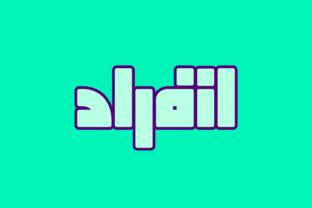
Most Arabic fonts are built on cursive principles, where letters connect naturally within words. This is the standard for body text and reading fluency. Enferad Arabic Font takes a different approach by treating each letterform as an independent shape. The result is a non-cursive typeface where characters do not connect, which changes both the visual rhythm and the reading experience. This is not a limitation but a deliberate design decision aimed at display contexts rather than extended reading.
The geometric structure of Enferad gives it a precise, almost architectural quality. Strokes are consistent in thickness, curves are regular and mathematically clean, and the overall impression is one of controlled order. The smooth rounded edges soften what might otherwise feel too rigid, adding a layer of approachability to the geometric foundation. This combination of precision and softness is what gives Enferad its distinctive visual personality.
Being a single-weight typeface, Enferad does not offer the range of thickness variations found in larger font families. This is an important practical point. You cannot toggle between light, regular, and bold versions within the same design system. What you get is one consistent weight, and the effectiveness of your typography depends entirely on how well that single weight suits your specific layout and hierarchy needs.
Strengths in Display and Titling Contexts
Enferad Arabic Font is designed primarily for display use, and this is where its strengths become most apparent. In headings, titles, posters, and hero sections, the non-cursive letterforms create a strong visual anchor. Each letter stands on its own, which can make words feel more deliberate and composed. This works especially well in large sizes where the geometric details and rounded corners become visible design features rather than background texture.
In web design, Enferad performs well for top-level headings, navigation branding, and call-to-action text. Its clean lines render crisply on screens, and the single weight eliminates the need to manage multiple font files for different heading levels. For marketing materials such as social media graphics, flyers, and advertising banners, the font provides a modern, uncluttered look that pairs well with minimal layouts and strong imagery.
Creative titling is another area where Enferad Arabic Font shows clear value. Because the letters do not connect, you can space them more freely, adjust tracking without breaking word shapes, and experiment with layout arrangements that would be difficult with cursive scripts. This gives designers more flexibility in poster design, logo exploration, and editorial headers where typography carries significant visual weight.
Practical Limitations to Consider
No typeface is perfect for every situation, and Enferad has realistic limitations worth noting. The most significant is its unsuitability for body text. The non-cursive structure slows reading speed compared to connected Arabic scripts, making it a poor choice for paragraphs, articles, or any content meant for sustained reading. Readers accustomed to standard Arabic typography may find the disconnected forms distracting in smaller sizes or longer passages.
The single weight also means you have limited options for creating typographic hierarchy within the same font family. If your project requires clear distinction between main headings, subheadings, and supporting text, you will need to pair Enferad with another typeface or rely on size and spacing alone to create visual separation. This is not necessarily a problem, but it requires thoughtful planning and good secondary font selection.
Additionally, the geometric style may not suit every brand or visual identity. Traditional, heritage, or highly decorative projects may feel mismatched with Enferad's modern and minimalist character. It is a typeface with a specific personality, and that personality will not blend into every background.
Who Benefits Most from Enferad Arabic Font
Understanding the intended audience helps determine whether Enferad Arabic Font fits your specific needs. Based on its design characteristics and real-world performance, the following groups are likely to find it most useful:
- Web designers and UI developers who need a clean Arabic typeface for headers, navigation, and interface elements where readability at medium to large sizes matters more than cursive tradition.
- Marketers and advertising professionals creating campaign visuals, billboards, social media assets, and promotional materials where a modern, uncluttered look supports brand messaging.
- Graphic designers and art directors working on posters, magazines, book covers, and editorial layouts that require distinctive titling with strong visual presence.
- Brand and identity designers exploring logo concepts or brand typography for businesses seeking a contemporary Arabic visual language.
- Content creators and publishers producing digital or print materials where short, impactful text needs to stand out without competing with decorative flourishes.
- Small business owners and entrepreneurs managing their own marketing who want a reliable, straightforward Arabic typeface for presentations, flyers, and online content without navigating complex font families.
For these users, Enferad Arabic Font offers a dependable tool that does what it sets out to do: provide clean, geometric, non-cursive display typography with a polished finish.
Real-World Performance and Usability
In practical testing across web and print contexts, Enferad maintains consistent rendering quality. The rounded edges hold up well at various sizes, and the geometric structure ensures predictable spacing even when tracking is adjusted. The font loads efficiently for web use, and its single-file format simplifies integration compared to multi-weight families.
Legibility is strong at display sizes down to roughly 18 to 24 pixels, depending on the medium. Below that range, the disconnected letterforms can start to feel fragmented, especially in shorter words or acronyms. This reinforces the importance of using Enferad primarily for larger text where its individual letters have room to breathe and register visually.
Pairing Enferad Arabic Font with a readable body text typeface is straightforward. Because its personality is distinctive but not aggressive, it complements many standard Arabic text fonts without clashing. A common approach is to use Enferad for headings and a more traditional cursive Arabic font for body content, creating clear contrast between structural and reading typography.
Evaluating Long-Term Value
For designers and creators who regularly work on Arabic display projects, Enferad Arabic Font provides lasting utility. Its single-weight nature means there is less to manage, and its distinctive style remains visually relevant across changing design trends. The geometric approach is not a passing fashion but a established design direction with staying power.
That said, the font is a specialized tool rather than a general-purpose workhorse. Its value depends on how often your work involves Arabic display typography that benefits from non-cursive, geometric forms. If your projects align with this need, Enferad becomes a reliable resource. If your work leans toward traditional editorial or long-form Arabic content, the font will see limited use and may not justify its place in your library.
Practical Recommendations for Getting the Most Out of Enferad
To use Enferad Arabic Font effectively, consider the following practical guidelines:
- Reserve it for display sizes. Use Enferad for headings, titles, and prominent text elements where its geometric character can be appreciated. Avoid using it for body copy or small text.
- Pair it with a complementary body font. Choose a readable cursive Arabic typeface for paragraphs and supporting content. This creates a clear typographic hierarchy and improves overall readability.
- Adjust tracking deliberately. Because the letters are non-cursive, you have freedom to adjust letter spacing without breaking word shapes. Use this to fine-tune visual density and alignment.
- Test at multiple sizes early. Before committing to Enferad in a layout, test it at the sizes you plan to use. Confirm that the disconnected forms read clearly and that the visual weight matches your design intentions.
- Consider color and background. The geometric shapes respond well to bold colors, gradients, and textured backgrounds. Experiment with these combinations to maximize visual impact.
Final Considerations
Enferad Arabic Font is a well-executed example of a non-cursive, geometric display typeface designed specifically for Arabic script. Its single weight, rounded edges, and independent letterforms give it a clean and modern personality that suits web design, advertising, and creative titling. It is not a replacement for traditional cursive Arabic fonts, nor is it intended to be. It is a specialized tool for specific contexts where clarity, structure, and contemporary style take priority over conventional flow and connectedness.
For professionals who work regularly with Arabic display typography and need a reliable geometric option, Enferad Arabic Font deserves consideration. Its strengths are clear, its limitations are manageable, and its design serves its intended purpose with consistency. The key is knowing when to use it and when to reach for something more traditional. In the right hands and the right projects, Enferad delivers exactly what it promises.