Caesar Dressing Pro: Where Marker Spontaneity Meets Greek Geometric Balance
Typography is often described as the art of invisible service — the best typefaces do their job without calling attention to themselves. But every so often, a font arrives that refuses to blend in, not because it is loud or chaotic, but because it carries a distinct personality that feels both familiar and refreshingly new. Caesar Dressing Pro, designed by Dathan Boardman of Open Window, is precisely that kind of typeface. It takes the structural bones of a classic Greek alphabet and reimagines them through the lens of a marker’s spontaneous stroke. The result is a font that feels hand-drawn yet geometrically grounded, experimental yet perfectly at home in modern design workflows. For anyone working in branding, content creation, or digital communication, understanding what makes Caesar Dressing Pro tick — and why a marker-inspired Greek alphabet resonates right now — offers a practical window into where typography is heading.
What Is Caesar Dressing Pro? A Marker’s Take on an Ancient Script
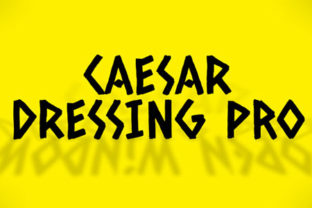
At its core, Caesar Dressing Pro is a reinterpretation of the Greek alphabet — not a revival of an ancient stone-carved inscription, but a lively, marker-drawn version that embraces the irregularities of human handwriting. Boardman, who leads Open Window, has built a reputation for typefaces that lean experimental, often capturing the energy of spontaneous lettering. Caesar Dressing Pro fits squarely within that ethos. It does not attempt to imitate the cold perfection of a digital vector. Instead, it preserves the quirks of a marker nib: slight pressure variations, uneven edges, and the subtle inconsistency that makes hand-rendered letterforms feel alive.
Yet despite its marker origins, the typeface does not abandon structure. As Boardman notes, it “maintains the geometric balance of a classic Greek font quite effectively.” That duality is its defining strength. You get the warmth and immediacy of something drawn in real time, combined with the proportional discipline that makes Greek letterforms inherently elegant. It is not a novelty font in the traditional sense — it is a considered piece of design that bridges two worlds: the rigid geometry of classical typography and the expressive freedom of contemporary marker work.
Why a Spontaneous Greek Alphabet Matters Right Now
Trends in typography rarely emerge in a vacuum. They respond to broader shifts in how people consume content, how brands communicate, and what audiences expect from visual media. Over the past several years, there has been a noticeable move away from sterile, corporate-looking typefaces toward styles that feel more human, more tactile, and less algorithmically perfect. The rise of hand-drawn logos, rough-edged display fonts, and lettering that appears to be written by an actual person rather than a machine signals a collective craving for authenticity in visual communication.
This is where Caesar Dressing Pro becomes especially relevant. It offers a Greek alphabet that does not look like it belongs solely on a museum plaque or a fraternity house wall. It feels present, immediate, and personal — as if someone sat down with a marker and wrote it. In a design landscape saturated with polished sans-serifs and overused geometric faces, a typeface with this kind of spontaneous energy stands out without trying too hard. It fits naturally into packaging, editorial headers, event branding, and digital content where the goal is to communicate approachability and craft, not just efficiency.
Moreover, the Greek alphabet itself carries cultural and intellectual weight. It is associated with academia, science, philosophy, and classical tradition. By rendering it in a marker style, Caesar Dressing Pro democratizes that weight — it takes something that might feel distant or overly academic and makes it accessible. For educators, bloggers, and content creators who work with topics rooted in history, language, or the sciences, this typeface offers a way to signal depth without sacrificing warmth.
How the Evolution of Display Typography Opened the Door for Fonts Like Caesar Dressing Pro
Typography has undergone a quiet revolution over the past two decades. The shift from print-first to screen-first design forced type designers to reconsider everything from hinting to readability at small sizes. But it also opened up new possibilities for display faces — fonts meant to be seen at larger sizes where personality matters more than legibility. As screens improved and variable font technology matured, designers began exploring styles that would have been impractical in the days of limited font embedding and low-resolution displays.
Open Window’s library has always gravitated toward the more experimental end of this spectrum. Boardman’s work often feels like a direct response to the rigidity of mainstream type design. Caesar Dressing Pro, in particular, benefits from a design environment where audiences are more visually literate and more tolerant — even hungry — for imperfections. The marker strokes, the slight wobble in the curves, the asymmetrical serifs — these are not flaws. They are features that communicate effort, humanity, and intention.
Compare Caesar Dressing Pro to the Greek fonts that dominated the market ten or fifteen years ago. Most were either faithful revivals of inscriptional lettering or clean, modern interpretations designed for signage and scientific notation. Very few attempted to inject the kind of spontaneous energy that marker-based drawing naturally produces. Caesar Dressing Pro fills that gap. It acknowledges that Greek letterforms do not always need to be sacred or solemn. They can be playful, rough, and present — and still retain the geometric balance that makes them timeless.
Practical Implications for Designers, Creators, and Businesses
Understanding the character of Caesar Dressing Pro is one thing. Knowing when and how to use it effectively is another. For professionals who work with typography daily — graphic designers, brand identity specialists, marketing leads, and content creators — this typeface offers a specific set of tools that can elevate visual communication in several contexts.
- Branding and identity. Businesses that want to convey a sense of artisanal quality, handcrafted care, or intellectual curiosity can use Caesar Dressing Pro in logos, labels, and packaging. Its marker texture pairs well with matte papers, kraft materials, and natural color palettes. It signals that the brand values tradition but is not afraid to express it in a contemporary way.
- Editorial and publishing. For magazines, journals, or online publications covering topics like philosophy, linguistics, archaeology, or classical studies, Caesar Dressing Pro can serve as an accent font for pull quotes, section headers, or title spreads. It adds visual interest without distracting from the content — assuming it is used sparingly and at appropriate sizes.
- Digital content and social media. In an era where scrolling users decide whether to engage in less than a second, typographic choices matter. A header set in Caesar Dressing Pro stands out against the sea of generic sans-serif text. It works especially well for YouTube thumbnails, Instagram stories, and presentation slides where the goal is to capture attention quickly and communicate a specific mood.
- Educational materials. Teachers, professors, and online course creators who introduce Greek roots, scientific terminology, or ancient history can use this typeface to make materials feel less intimidating and more approachable. The marker style suggests a hand-written note rather than a textbook transcription, which can help lower the barrier for learners.
One caution: because Caesar Dressing Pro carries such a strong personality, it should not be used for body text or long reading passages. Its strength lies in display settings — headlines, logos, short titles, and accent elements. Used at small sizes or in dense blocks, the marker irregularities can compromise readability. This is not a limitation; it is a design constraint that signals thoughtful use. The best typefaces know their role, and Caesar Dressing Pro knows it is meant to lead the eye, not carry the weight of an entire document.
Realistic Examples: Where Caesar Dressing Pro Shines
Consider a small independent bookstore that specializes in rare editions and translated works. Its owner wants a logo that feels scholarly but not stuffy, cultured but not pretentious. A logotype set in Caesar Dressing Pro, paired with a clean modern sans-serif for secondary text, communicates exactly that balance. The Greek-inspired letterforms hint at the breadth of the inventory, while the marker texture keeps the brand from feeling like a museum.
Or take a podcast series about the etymology of scientific terms. The cover art and title slides use Caesar Dressing Pro for the show name, set against a dark textured background with simple geometric icons. Listeners immediately register a sense of depth — the typeface suggests authority, but the rough edges signal that the host is approachable and the content is accessible. That combination is hard to achieve with more conventional Greek fonts.
For a craft spirits label that uses Greek mythology as its theme, Caesar Dressing Pro offers a way to reference classical stories without falling back on overused serifs. The marker strokes echo the handcrafted nature of the product itself — small batch, carefully made, unapologetically authentic. The typeface becomes part of the narrative, not just a label on a bottle.
How to Work with Caesar Dressing Pro: Practical Recommendations
If you are considering adding Caesar Dressing Pro to your toolkit, here are a few grounded recommendations based on how it behaves in real design environments.
- Use it at display sizes. Aim for 36 points and above. At smaller sizes, the marker inconsistencies can blur or appear muddy, especially on screen. Reserve it for headlines, titles, and short call-outs.
- Pair it with neutral, clean typefaces. Because Caesar Dressing Pro carries so much visual texture, combine it with a simple sans-serif or a refined serif for body copy. This creates contrast without competition.
- Let it breathe. Generous letter spacing and ample white space around the text will enhance the marker effect. Crowding the letters compresses the visual energy that makes the font interesting.
- Consider the medium. On paper — especially uncoated or textured stock — Caesar Dressing Pro performs beautifully. On screen, test it at the sizes and resolutions you intend to use. Some marker details may soften on low-DPI displays.
- Stay true to the tone. This typeface works best in contexts that value handcraft, authenticity, and intellectual curiosity. It will feel out of place in ultra-corporate, high-tech, or minimalist environments that demand frictionless perfection.
The Broader Takeaway: Why Fonts Like Caesar Dressing Pro Are Not a Passing Fad
There is a temptation to categorize marker-style Greek alphabets as niche or trend-driven. But Caesar Dressing Pro feels different. It is not a gimmick. It is a thoughtful response to a persistent need in typography: the need for typefaces that carry both historical resonance and human warmth. As communication continues to move through digital channels that can feel impersonal and homogenized, the demand for lettering that shows a human hand will only grow.
Boardman and Open Window have contributed to that shift with a font that does not sacrifice structure for spontaneity. Caesar Dressing Pro holds its own beside the most experimental typefaces in the Open Window library, yet it never abandons the geometric discipline that makes Greek letterforms inherently beautiful. For designers, creators, and businesses looking to communicate with clarity and character, that balance is exactly what makes it worth exploring.
Typography, at its best, is invisible — until it is not. Caesar Dressing Pro invites you to notice it, to appreciate the marker marks, and to remember that even the most ancient alphabets can still feel newly drawn.