Why Karlie School Is Changing How Children Learn to Write
There is a quiet revolution happening in classrooms and home learning spaces, and it starts with something surprisingly simple: a font. For years, teachers and parents have struggled with worksheets that just don't work the way children actually learn to write. The letters are too narrow, the spacing is inconsistent, and the tracing guides either confuse young eyes or fail to provide enough structure. Then came Karlie School, a typeface born from a very real, very specific problem that one teacher faced every single day.
This is not just another font. It is a teaching tool, carefully crafted to bridge the gap between what educators need and what typical typography offers. Whether you are a seasoned teacher preparing next week's handwriting lesson or a parent helping a kindergartner form their first letters, Karlie School brings something rare to the table: it was designed for the classroom, by someone who understood the classroom intimately.
Where Karlie School Comes From
Every great educational tool has a story, and Karlie School's begins with a teacher who could not find what she needed. A member of the typographer's own family was working in education, and she kept running into the same wall. The fonts available for handwriting worksheets were either too decorative to be practical or so generic that they offered no real guidance for young students. She needed something specific: clear letterforms, consistent sizing, and the ability to show students exactly where to start and stop each stroke.
So the typographer got to work. The result is a font family that feels like it was made for the job because it literally was. Karlie School was designed with one purpose in mind, and that focus shows in every character. The lowercase a and g use the simple, rounded forms that children are first taught, not the more complex shapes found in adult typefaces. The letter heights are proportional and predictable. The spacing is generous enough that young writers can see each letter as its own shape, which is crucial when they are still learning to distinguish between similar characters like b, d, p, and q.
Three Fonts, One Purpose
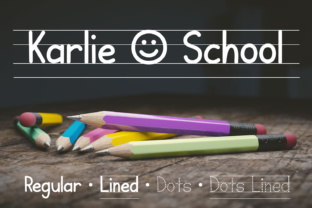
One of the most practical things about Karlie School is that it is not actually a single font. It is a collection of styles, each designed for a different stage of the learning process. This is where the font truly shows its classroom pedigree. A teacher knows that you do not hand a student a blank line and ask them to write perfectly on the first try. You start with guidance, then slowly remove the scaffolding as the child gains confidence.
The Basic Handwriting Font
This is the foundation. The basic handwriting style uses clean, simple letterforms with no extra frills. It is perfect for worksheets where the goal is recognition and practice. When you place a word in this font on a page, a child sees exactly what they are supposed to write, with nothing confusing or distracting. This style works beautifully for word lists, spelling practice, and short sentences that students will copy by hand. The letters are large enough for young eyes to follow but not so oversized that they feel childish to older students who still need handwriting practice.
The Dotted Tracing Font
This is where Karlie School really shines. The dotted tracing version creates a faint, dashed outline of each letter, and the child traces over it with a pencil. But there is an art to making this work effectively, and Karlie School gets it right. The dots are spaced closely enough that the child's pencil stays on track, but not so tightly that the line becomes a solid mass. The letter shapes remain perfectly clear, so the student is not guessing where the curve of a c or the loop of an e should go.
What makes this font different from the tracing fonts many teachers have tried before is the attention to stroke direction. When a child traces a letter, they are not just copying a shape. They are building muscle memory. Karlie School's dotted version supports proper stroke order because the letterforms themselves encourage the right flow. A d starts with the circle, then the tall line. An m has three clear bumps, each one leading naturally into the next. This may sound like a small detail, but for a five-year-old learning to write their name for the first time, it makes all the difference.
The Guideline Versions
Perhaps the most teacher-friendly feature of Karlie School is the built-in guideline system. Every educator knows the classic three-line setup: a top line for tall letters, a middle dashed line for the x-height, and a bottom line for the baseline. Some fonts require you to create these lines manually using text boxes and drawing tools, which is tedious and often ends up looking uneven. Karlie School includes versions where the guidelines are part of the font itself. You simply type, and the lines appear exactly where they should be.
This is a massive time saver. Creating a worksheet that used to take twenty minutes of careful formatting can now be done in two. Type the word, adjust the size, print. The guidelines are always the right distance apart, always the right thickness, and always in a color that does not overpower the student's own writing. There are even variations with different line colors and styles, so you can choose what works best for your students' visual needs.
Why Handwriting Fonts Matter More Than You Think
It is easy to assume that in an age of tablets and keyboards, handwriting instruction is becoming less important. But research consistently shows the opposite. Learning to write by hand activates different neural pathways than typing. It improves letter recognition, reading comprehension, and even memory. Children who struggle with handwriting often avoid writing altogether, which can hold back their development in other subjects. A font that makes handwriting practice easier and more effective is not a niche product. It is a tool that supports a fundamental skill.
Karlie School understands this. The font does not try to be cute or trendy. It prioritizes clarity and consistency. Every letter in every style follows the same rules, so once a student learns the shape of k in the tracing font, they recognize it immediately in the basic version. This consistency builds confidence. And confidence is what turns a reluctant writer into a child who fills whole pages with stories and lists and letters to grandparents.
Practical Uses in the Classroom and at Home
If you are a teacher, Karlie School can transform how you prepare handwriting materials. You can create custom worksheets for any vocabulary list, spelling unit, or phonics lesson. Need a page of th words for a struggling reader? Type them in the dotted tracing font and you have an instant practice sheet. Want to challenge advanced students with longer sentences? Use the basic font with guidelines and let them copy a short passage. The flexibility means you are not locked into pre-made workbooks that may or may not match your curriculum.
For homeschooling parents, Karlie School is equally valuable. You do not need to be a professional teacher to see the difference it makes. Print out a few practice sheets each week, and let your child work at their own pace. The built-in guidelines mean you do not have to draw lines by hand, and the tracing font means you can give your child the support they need without hovering over every letter. Many parents report that their children actually enjoy handwriting practice more when the worksheets look clean and professional, which is a small but meaningful victory.
Tutors and therapists who work with children on fine motor skills will also find Karlie School useful. The consistent letter shapes make it easier to assess a child's progress. You can see clearly whether the issue is with forming a specific letter or with general handwriting habits. And because the font is available in multiple styles, you can gradually increase difficulty as the child improves, moving from tracing to copying to independent writing.
What to Look for When Choosing a Handwriting Font
Not all handwriting fonts are created equal, and the wrong one can actually cause problems. Some common issues include letters that are too narrow, which makes cursive transitions difficult later. Others use stroke patterns that do not match the standard handwriting curriculum taught in most schools. A few fonts are simply not designed for children at all, with letterforms that look fine on screen but confuse young writers on paper.
Karlie School avoids all of these pitfalls because it was designed with actual handwriting instruction in mind. The letter proportions are generous, the stroke directions match standard teaching methods, and the fonts are thoroughly tested in real classrooms. If you are comparing options, look for a font that offers multiple styles, clear guidelines, and consistent letter shapes. Karlie School checks all of those boxes.
Getting Started with Karlie School
Downloading and using Karlie School is straightforward. The font installs like any other typeface on both Windows and Mac systems, and it works with word processors, worksheet creators, and design software. Once installed, you simply select the style you need, choose a size that suits your students, and start typing. The learning curve is minimal because the font does all the heavy lifting.
Start with the dotted tracing version for students who are still learning letter shapes. Move to the basic handwriting font with guidelines once they can trace confidently. And when they are ready to write independently, use the guideline version without the tracing dots. This progression mirrors how handwriting is actually taught, and it saves you from having to create three separate sets of materials for every lesson.
Karlie School is more than just a font. It is a tool that respects the work teachers and parents do every day. It acknowledges that teaching a child to write is a patient, step-by-step process, and it provides the right support at every stage. If you have been frustrated by worksheets that do not quite work or fonts that look good but teach poorly, this is worth your time.
Download Karlie School today and see what happens when a font is designed not for aesthetics alone, but for the real, messy, rewarding work of teaching a child to write.