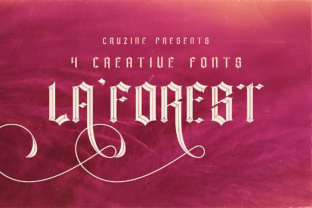
La Forest: A Blackletter Display Font for Vintage and Fairytale-Inspired Design
When a design project calls for a sense of history, mystery, or handcrafted charm, the choice of typeface often makes the difference between a generic result and one that feels genuinely evocative. Among the many vintage-inspired fonts available today, La Forest stands out as a carefully constructed gothic text that recalls old, fairytale‑style illustrations and hand‑set type. Its blend of blackletter structure with delicate decorative touches gives it a distinctive place in the toolbox of designers working on book covers, posters, packaging, or brand identities that need a dark, romantic, or antique feel.
This article examines what makes La Forest unique, where it performs best, and how it compares with other vintage or gothic type options. The goal is to help you decide whether this font fits your project’s needs—or whether an alternative might serve you better.
What Makes La Forest Distinct?
La Forest is a display font built on a blackletter foundation, but it isn’t a strict historical reproduction. Instead, it takes the angular, vertical strokes and ornate caps characteristic of medieval manuscript hands and softens them with flourishes that feel more illustrative than formal. The letterforms have a slightly irregular, hand‑drawn quality—like ink on aged paper—which immediately evokes storybook illustrations from the late 19th and early 20th centuries.
Key stylistic features include:
- High contrast between thick and thin strokes, which adds drama and rhythm to text blocks.
- Decorative ascenders and descenders that sometimes curl into leaves or vine‑like shapes, reinforcing the “forest” theme.
- Alternate glyphs and ligatures (in OpenType versions) that let you customize the texture of a word or headline.
- A slightly condensed appearance that works well in limited horizontal space, such as book spines or narrow poster columns.
These elements make La Forest more than a neutral blackletter. It carries a narrative quality—it tells a story before you’ve read a single word. For designers working on projects related to folklore, fantasy, dark romance, or antique advertising, this intrinsic storytelling can be a major asset.
Comparing La Forest with Other Vintage and Gothic Styles
To evaluate La Forest fairly, it helps to understand the broader landscape of vintage‑inspired typefaces. The category includes several sub‑styles, each with different strengths and tradeoffs.
Blackletter vs. Gothic Sans Serif
Many designers confuse blackletter fonts (like La Forest) with “gothic” sans‑serif styles such as Franklin Gothic or Trade Gothic. The two categories share the word “gothic” but are unrelated: blackletter derives from medieval calligraphy, while gothic sans‑serif is a 20th‑century modernist invention. If your project needs a clean, industrial, or mid‑century feel, La Forest would feel anachronistic. A gothic sans would be a better fit. If you need the look of an illuminated manuscript, a medieval scroll, or a Gothic horror novel cover, La Forest is far more appropriate.
La Forest vs. Traditional Blackletter
Traditional blackletter fonts—like Old English Text MT, Cloister Black, or Fraktur styles—are often very rigid and symmetrical. They can look stiff or overly formal for modern design. La Forest departs from that rigidity: its slight irregularities and decorative swashes give it a softer, more organic hand. This makes it less suitable for very formal documents (like diplomas or official certificates) but much better for creative, editorial, or packaging work where you want character over authority.
La Forest vs. Fairytale / Storybook Fonts
Fairytale‑inspired fonts range from overly cute script faces to rough wood‑type revivals. La Forest sits at the darker end of that spectrum. It doesn’t aim for whimsy—it has a somber, mysterious quality that works for stories like the Brothers Grimm or Edgar Allan Poe, rather than Disney‑style princess tales. If you need a lighter, more playful storybook feel, a rounded serif or a bouncy script might be a better match. But for projects that need depth, texture, and a hint of menace, La Forest is a strong candidate.
Strengths and Tradeoffs: Where La Forest Excels and Where It Struggles
No single typeface is right for every situation. Understanding La Forest’s strengths and limitations will help you use it effectively—or avoid it when it would be a mismatch.
Strengths
- Strong visual impact at display sizes. La Forest shines in headlines, titles, and short phrases. Its intricate details become clear and readable at 18 pt and above, and the decorative flourishes add real value to poster designs and book covers.
- Evokes a specific era and mood. If your project targets an audience that appreciates vintage aesthetics, folklore, or Gothic literature, La Forest instantly communicates that without extra visual elements.
- Customization through alternates. The availability of stylistic sets (in OpenType‑savvy applications like Adobe InDesign or Illustrator) lets you avoid repetitive letterforms and tailor the texture to your layout.
- Works well with understated typography. Because La Forest is ornate, it pairs gracefully with simple sans‑serif or neutral serif fonts for body text. The contrast can be quite appealing.
Tradeoffs and Limitations
- Limited readability in long text. Like most blackletter fonts, La Forest is not designed for body copy. Extended reading in La Forest would strain the eyes, and the decorative strokes can crowd together at smaller sizes. Use it only for short passages or display use.
- May feel too dark or heavy for some brands. The gothic, forest‑inspired tone can be off‑putting if you need a friendly, approachable, or professional corporate identity. It tends to dominate a page, leaving little room for subtlety.
- Potential overuse of “medieval” tropes. Because La Forest borrows strongly from fairytale illustration, it can feel cliché if applied to every project with a vague vintage theme. Consider whether the mood truly calls for this level of ornamentation.
- Compatibility with less‑advanced software. If you work in basic word processors or web design tools that don’t support OpenType features, you may lose access to the alternate characters that make the font special. The basic alphabet is still usable, but the missing ligatures and swashes can make the text feel less polished.
Realistic Use Cases for La Forest
To help you decide, here are several scenarios where La Forest tends to perform well—and a few where it’s likely to be the wrong choice.
Good Fit
- Book covers for fantasy, horror, or historical fiction. A title like “The Dark Wood” or “Secrets of the Abbey” gains immediate atmosphere from La Forest’s lettering.
- Event posters for Renaissance fairs, Halloween parties, or classical music concerts (e.g., medieval or folk). The font’s visual weight works well when paired with a simple background and limited color palette.
- Product labels for artisanal goods with a rustic or antique identity – craft beer, small‑batch spirits, handmade soaps, or gourmet preserves. La Forest can imply heritage and craftsmanship when used sparingly.
- Wedding or invitation suites with a dark romantic or Gothic theme. Paired with soft floral graphics or wax seals, La Forest creates a cohesive, moody aesthetic.
Less Appropriate Fit
- Corporate reports, legal documents, or professional correspondence. The formality is not the right kind; a clean serif or sans‑serif would be more appropriate.
- Children’s books aimed at very young readers. The font’s complexity can hinder legibility for early readers, and the tone may feel too severe for lighthearted stories.
- Minimalist, modern brand identities that rely on simplicity. La Forest’s ornamentation would conflict with a clean, open layout.
- Very small text (e.g., footnotes, captions, body copy below 14 pt). At that size, details blur and the font becomes hard to read.
Decision Factors: How to Choose La Forest Over Alternatives
When you’re researching vintage typefaces, you’ll encounter many options that might seem similar at first. The following decision framework can help you identify whether La Forest is the right fit for your specific project.
- Assess the mood you need. If you want dark, mysterious, or romantic with a historical bent, La Forest is a strong contender. If you want light, playful, or elegant without the gothic edge, consider a different style.
- Evaluate the reading distance and size. Will your text be seen from a distance (poster, sign) or held close (book, invitation)? La Forest works best when viewed at moderate to large sizes.
- Consider the software and output format. Do you need OpenType alternates? Will you be printing or using web fonts? La Forest is commercially available in standard formats (OTF, TTF, WOFF), but its full value is unlocked with OpenType support.
- Think about pairing. Can you find a complementary body text face that doesn’t compete with La Forest? A simple, clean sans like Lato or a humanist serif like Source Serif can work. If the pairing feels awkward, the font may not be right for that application.
- Test the font in context. Before committing, typeset a sample of your actual content. Many foundries offer trial versions. Seeing “La Forest” in your own layout—with your colors and imagery—will reveal whether it aligns with your vision.
When Another Option Might Serve Better
La Forest is not a universal solution. If your project demands readability at small sizes, a more legible blackletter like Cardo or Fette Fraktur (with OpenType features) might be a better choice. If you need a lighter, more elegant vintage feel, a copperplate script or a serif like Jenson could be more appropriate. And if you’re working with strict brand guidelines that require a neutral, modern tone, La Forest would be a mismatch.
The key is to match the typeface’s emotional and historical weight to the message you need to convey. La Forest carries a specific flavor—forest‑dark, hand‑drawn, and storybook‑rich—that not every project can accommodate. When it does fit, however, it adds a layer of depth and authenticity that few other display fonts can match.
Final Thoughts on Using La Forest
La Forest is a well‑crafted tool for designers who need a gothic display font with a fairytale soul. Its strengths lie in visual impact, mood creation, and decorative detail. Its limitations center on readability, formality, and the risk of thematic overreach. By understanding both sides, you can make an informed decision about whether La Forest belongs in your project—or whether you should look elsewhere for the perfect vintage voice.
As with any typeface, the best test is practical use. Try La Forest in a few headline treatments, pair it with supporting fonts, and see if it evokes the response you’re aiming for. If it does, then you’ve found a resource that can give your design an authentic, old‑world character that resonates with audiences who appreciate the artistry of hand‑crafted lettering.