Demented Font Review: A Deliberately Distorted Take on Franklin Gothic
What Demented Is and Why It Deserves Attention
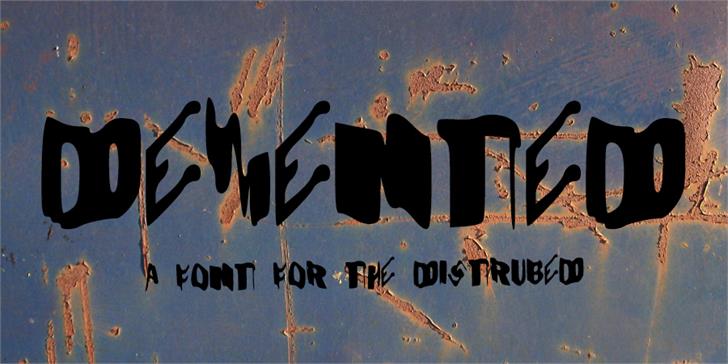
Most typefaces are designed with clarity, legibility, and consistency as non-negotiable priorities. Demented takes the opposite approach. Built on the bones of Franklin Gothic—a sturdy, no-nonsense American sans-serif—this font deliberately distorts, skews, and warps each character until it looks convincingly drunk. The result is a typeface that feels less like a tool for reading and more like a visual performance. For designers who work with expressive, chaotic, or narrative-driven projects, Demented offers something genuinely different: a font that communicates instability, intoxication, or raw emotional disorientation without relying on gimmicky extra effects.
The choice of Franklin Gothic as a starting point is worth noting because it provides the structure that makes the distortion readable. Franklin Gothic’s even strokes, upright posture, and familiar proportions mean that even when each letter tilts, wobbles, or collapses slightly, the underlying skeleton remains recognizable. That balance between order and disorder is what gives Demented its practical edge. It does not dissolve into illegible scribble; it holds together enough to be read while still feeling genuinely unhinged.
Key Characteristics and What Makes It Distinct
Demented retains the essential anatomy of Franklin Gothic—the squared-off lowercase a, the broad n and m, the assertive caps—but then applies irregular rotation, subtle compression, and variable baseline drift across many characters. Some letters lean left, others right. A few appear slightly stretched or condensed, as though someone squinted hard while setting the type. The overall effect is uneven but not random. There is a controlled looseness that suggests careful manual intervention rather than a simple algorithmic wiggle filter.
The font includes standard uppercase and lowercase characters, numerals, and basic punctuation, all treated with the same unstable treatment. Several glyphs show more distortion than others, which prevents the text from looking like a uniform shake effect. Instead, it reads as though the letters fought against gravity on their own terms. That variation is important because it mimics actual drunkenness or disorientation, where some words come out slurred and others land close to normal.
Practical Strengths of the Design
- Readability under chaos: Despite the warping, the Franklin Gothic base keeps even heavily distorted letters decipherable in short phrases and headlines.
- Consistent inconsistency: The irregularity feels intentional across the character set, so the font does not break down into unreadable symbols in longer text blocks.
- Single-weight utility: Demented works as a standalone statement piece without requiring multiple weights or companion fonts to communicate its mood.
Real-World Performance and Use Cases
Demented performs best in applications where the message itself is fractured, impaired, or emotionally raw. A poster for a film about addiction, an album cover for a grunge or punk band, a horror game interface, or a social media campaign addressing mental health—these are natural homes for this typeface. The font becomes a narrative element rather than just a delivery system for text. In those contexts, Demented does not distract; it reinforces.
In more commercial or polished settings—corporate presentations, legal documents, health communications, product packaging with a clean brand voice—Demented would feel out of place and potentially confusing. It is not a versatile workhorse. It is a specialized tool for specific tonal needs. The designer who reaches for Demented should already know the message calls for something unstable.
One practical concern is legibility in smaller sizes. Demented works well at display sizes of 24 points or larger, where the distortion reads as intentional and expressive. At body text sizes—10 to 14 points—the warping can make individual characters harder to distinguish, especially for readers encountering the font for the first time. If the goal is to convey disorientation over long passages, that reduced legibility might be exactly the point. But if the text also needs to communicate clear information, consider pairing Demented with a neutral, stable sans-serif for body copy and reserving the distorted face for headers or emphasized phrases.
Pairing Suggestions for Professional Use
- Use Demented for headlines or callouts at 30 pt or larger.
- Pair with Franklin Gothic Book or Medium for body copy to maintain visual continuity.
- Avoid mixing with decorative, script, or overly ornate fonts, as the tension can become visually noisy.
- Limit Demented to single-word or short-phrase treatments in layouts with multiple typefaces.
Quality, Usability, and Technical Considerations
Demented is a well-crafted typeface when evaluated on its own terms. The distortion is not random; each glyph shows deliberate manipulation that respects the original anatomy. The kerning is handled thoughtfully, which matters because inconsistent spacing would ruin the illusion of controlled chaos. Ascenders and descenders stay within predictable boundaries, so the font does not cause layout collisions even when lines stack tightly.
The font files typically include OTF and TTF formats, with basic OpenType features such as standard ligatures and case-sensitive punctuation. There are no stylistic sets, swashes, or alternates in most builds, so what you see is what you get. That simplicity works in Demented’s favor: because the character set remains standard, there are fewer decisions to make during layout. You set the text, scale it up, and let the distortion do the work.
One limitation worth noting is the absence of a companion italic or bold weight. The regular weight is the only offering in most versions, which means emphasis within Demented itself must come from size changes, color, or surrounding neutral type. For projects that require multiple levels of hierarchy within the same distorted voice, this can feel restrictive. That said, the singular weight reinforces the font’s identity as a one-note instrument. It does not pretend to be a full type system, and that honesty is part of its value.
Presentation and Effectiveness Across Media
Demented translates well across both print and digital environments. On screen, the uneven strokes remain clear at high resolution, though older or low-resolution displays may exaggerate the distortion into muddiness. Testing at the intended output size is recommended before committing to large runs of printed materials. On paper, especially in offset or digital print, the font retains its rough character without losing definition. It pairs naturally with distressed textures, grain effects, and muted or desaturated color schemes.
For motion graphics, Demented can be animated to amplify its already unsteady appearance. A subtle jitter or slow drift on each character reinforces the drunken feel without making the text hard to follow. That kind of use is common in title sequences for indie films, video game trailers, or web series that need a visceral, unfiltered visual tone.
Who Benefits Most from Demented
Demented is not for every designer or every project. However, for specific audiences and contexts, it delivers a unique value that few other typefaces can match.
- Album and poster designers working in punk, grunge, metal, lo-fi, or experimental genres will find Demented immediately useful. It communicates a raw, unpolished mood without extra effects.
- Game developers creating horror, survival, or narrative-heavy titles can use Demented for UI elements, title screens, and in-game signage where the world feels unstable or threatening.
- Social media creators and content marketers targeting audiences that respond to authentic, messy, or emotionally honest visual branding may leverage Demented to break away from polished corporate aesthetics.
- Independent publishers and zine makers producing printed matter with a DIY or underground sensibility will appreciate how the font adds character without requiring elaborate layout work.
- Motion designers seeking a base typeface for kinetic or distorted text animations can rely on Demented to already include the visual instability they would otherwise have to add manually.
Conversely, professionals working in corporate branding, legal communications, medical information, e-commerce product descriptions, or any context where clarity and trustworthiness are paramount should avoid Demented. Its very design communicates impairment, which is the opposite of what those audiences need.
Long-Term Value and Versatility Considerations
Demented is not a font that ages into neutrality. It remains a niche choice, and its value depends entirely on how often a designer encounters projects that call for that niche. For a designer who regularly works on mood-driven, narrative, or genre-specific media, Demented earns its place in the library. For someone whose work leans toward clean, accessible, or mainstream communication, it may see use once or twice a year at most.
That limited frequency is not a flaw—many of the best typefaces are specialists. But it is worth considering before purchasing or licensing Demented for a general-use collection. The font shines when it is the right tool, but it does not stretch far beyond that range.
Final Professional Observations
Demented succeeds because it understands that distortion without structure is noise, but distortion built on a strong skeleton is expression. Franklin Gothic provides the skeleton, and the designer’s modifications add the voice. The font is not trying to be beautiful or neutral or universal. It is trying to feel drunk, and it achieves that goal with consistency and craft.
For the designer who needs a typeface that looks hungover, hostile, or barely holding together, Demented delivers a solution that feels considered rather than cheap. It is a font with a clear point of view and a narrow but deep lane of usefulness. If that lane matches your project, Demented will serve it better than any alternative. If it does not, the font will feel like noise. That honesty is the mark of a well-made specialist tool.